Aéroports de la Côte d’Azur is committed to developing protecting the environmental.
Conscious of our responsibility towards the rich biodiversity of our region, we are deeply committed to preventing pollution and building a sustainable future.
It is therefore vital that we assess and limit the environmental impact of our operations.
Using our approach, which is based on proactive risk and noise prevention, we implement concrete measures to minimise our footprint and optimise our use of resources.
-
Noise pollution
See more See lessNice Côte d'Azur Airport measures all aircraft landings and taking offs daily, using 10 noise sensors located on and around the airport and radar trajectories.
Over the years, Nice Côte d'Azur Airport has also developed its air navigation procedures and introduced numerous operating rules to contain, control and reduce the impact of aviation activity on its environment.
More information in the residents' section
-
Waste management and the circular economy
See more See lessWe aim to reduce our waste at source and ensure that any waste is sorted and treated, with particular attention paid to hazardous materials.
Recycling
To increase the proportion of waste recycled, we commissioned a study of the waste generated by our activities. This led to introducing a system of source separated recycling, for both airport professionals and passengers, which allowed us to make progress towards our goal of recovering household packaging, the main waste stream produced by our passengers and shops.
Donations and Reuse
We are tackling obsolescence and waste by donating items confiscated at the security check points as well as lunchboxes to the Restos du Cœur charity.
-
Air Quality
See more See lessThe Côte d’Azur Airports are actively committed to preserving air quality and combating climate change. For more than twenty years, the group has been funding daily monitoring campaigns of various pollutants, in partnership with AtmoSud:
- Since 2005: nitrogen oxides and ozone;
- Since 2007: fine particulate matter PM10;
- Since 2017: fine particulate matter PM2.5;
- Since 2023: ultrafine particles (UFP).
EVOLUTION OF POLLUTANTS AT NICE AIRPORT
A study produced by AtmoSud in 2025 highlighted several findings:
First, nitrogen dioxide concentrations have decreased by 42% compared to 2006. “The gradual decrease in levels over the past 20 years confirms the effectiveness of action plans and is encouraging for meeting WHO recommendations,” states AtmoSud.
Regarding fine particles, the report indicates that “road traffic and the residential sector are responsible for 80% of PM10 and PM2.5 emissions (…). Less than 4% of PM10 and PM2.5 emissions are linked to air traffic.”
As for ultrafine particles, comparison with the urban monitoring site in Nice – Villa Arson shows higher levels at the airport, particularly during the daytime, consistent with periods of airport activity.
THE MONITORING STATION IS BEING RELOCATED
The AtmoSud air quality monitoring station, located at Nice Côte d’Azur Airport since 2005, will be moved closer to the runway threshold. This change offers the significant advantage of better monitoring emissions from the aviation sector. The study conducted helped guide the decision regarding the station’s relocation.
Thus, between October 2025 and January 2026, AtmoSud carried out an intercomparison campaign. The objective was to assess the comparability of measurements taken at the current site with those that will be taken at the new site, in order to preserve historical data while refining results.
First lesson: monitoring of PM10 fine particles, which showed high concentrations during the pandemic when airport activity was almost at a standstill, will be discontinued. As the report states, this measurement “is not relevant to airport-related issues, which, considering its historical data, leads to focusing monitoring on finer particles, PM2.5.”
Second lesson: “A relocation of less than 300 meters does not affect the overall dynamics of the pollutants monitored. It also has no impact on ozone and PM10 and PM2.5 levels, which are homogeneous across the Nice metropolitan area.”
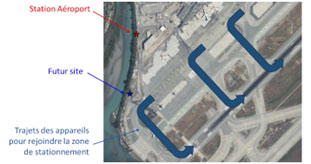
While, unsurprisingly, UFP levels increase in connection with airport activity, “nitrogen dioxide concentrations are 20% lower, consistent with increased distance from road traffic sources and a more ventilated environment, without calling into question the need to monitor this pollutant, which is also emitted by aircraft.”
Based on these findings, the relocation of the station has been validated by AtmoSud and will take effect in 2026.